The Right Way to Bench Press as a Beginner
The bench press is a foundational strength move, but small setup errors cost you muscle and invite injury. Here's the complete beginner's guide to getting it right.
Why Bench Press Form for New Lifters Makes or Breaks Your Progress
You want to build a bigger chest and stronger upper body. The bench press is the tool for the job. But knowing how to bench press correctly for beginners isn't just about putting weight on the bar and pushing — your setup, grip, and shoulder position determine whether you build muscle efficiently or spend months nursing an injury.
This article walks you through the exact mechanics behind a safe, effective bench press, the step-by-step setup process, and the most common technical errors that derail new lifters. Get these fundamentals right from day one and every future session builds on solid ground. Ignore them, and you're stacking weight on a fault line.
The Biomechanics That Make Bench Press Shoulder Safety Tips Non-Negotiable
The shoulder is the most vulnerable joint in the bench press. Musculoskeletal pain and injuries associated with the bench press are a common problem among elite and recreational lifters, especially at the shoulder complex. Understanding why that happens gives you the tools to prevent it.
Grip Width and Shoulder Loading
How you grip the bar directly changes the forces running through your shoulder joints. Research has demonstrated that a wide grip (greater than 1.5 biacromial width) may increase the risk of shoulder injury, including anterior shoulder instability, osteolysis of the distal clavicle, and pectoralis major rupture. Reducing grip width to at or below 1.5 biacromial width appears to reduce this risk and results in only a ±5% difference in one repetition maximum. For a beginner, that's a near-zero cost to your strength and a major gain in joint safety.
Biacromial width is simply the distance between your two shoulder joints. A grip at 1.5 times that distance lands most people with their hands just outside shoulder width, forearms roughly vertical when the bar touches your chest. That vertical forearm position matters: your hands should be in a position that places your forearms perpendicular to the barbell when it is resting on your chest. In this position, your entire shoulder girdle is sharing the load.
Scapular Retraction and Shoulder Stability
Scapular retraction is the act of squeezing your shoulder blades together and slightly down before you unrack the bar. It creates a stable platform and protects the glenohumeral joint throughout the press. Scapula retraction decreased glenohumeral posterior shear force components and rotator cuff activity, and may decrease the risk for glenohumeral instability and rotator cuff injuries.
Think of it as building a shelf with your upper back. With retracted scapulae, you effectively shorten the distance the load must be moved. By keeping the scapulae in contact with the bench, you create an artificial stability — and thus a more stable base from which to generate force.
You don't need to crush your shoulder blades together with maximum force. A moderate retraction followed by depressing them down toward your hips is the practical cue. Lock that position before you touch the bar, and hold it through every rep.
Bar Path: The Difference Between Novice and Efficient Pressing
Most beginners push the bar in a straight vertical line. That's intuitive but mechanically wasteful. Novice lifters initiate the press by shoving the bar essentially straight up off their chest, with the bar path angled back only slightly. Since the bar doesn't move back toward the shoulders very much, total flexion demands at the shoulders remain very high relative to the load being lifted when the bar reaches the sticking point.
The more efficient bar path descends at a slight diagonal from above your shoulders down to your lower chest, then drives back up and slightly toward your face on the way to lockout. The best bench press bar path is one where the barbell follows a slightly curved descent and then a "J" curve on the ascent, involving pushing the bar toward your head as you come off the chest and then moving into a vertical bar path closer to lockout.
How to Bench Press Correctly for Beginners: The Full Setup
Execute these steps every single time you bench. Consistency in setup is what separates a developing lifter from one who stalls early. For broader context on why form precision matters so much, see why proper form matters in weightlifting.
-
Set the rack height. The bar should sit in the uprights at a height you can unrack with slightly bent elbows. Too high and you fight to get it out; too low and you waste energy before the set even starts.
-
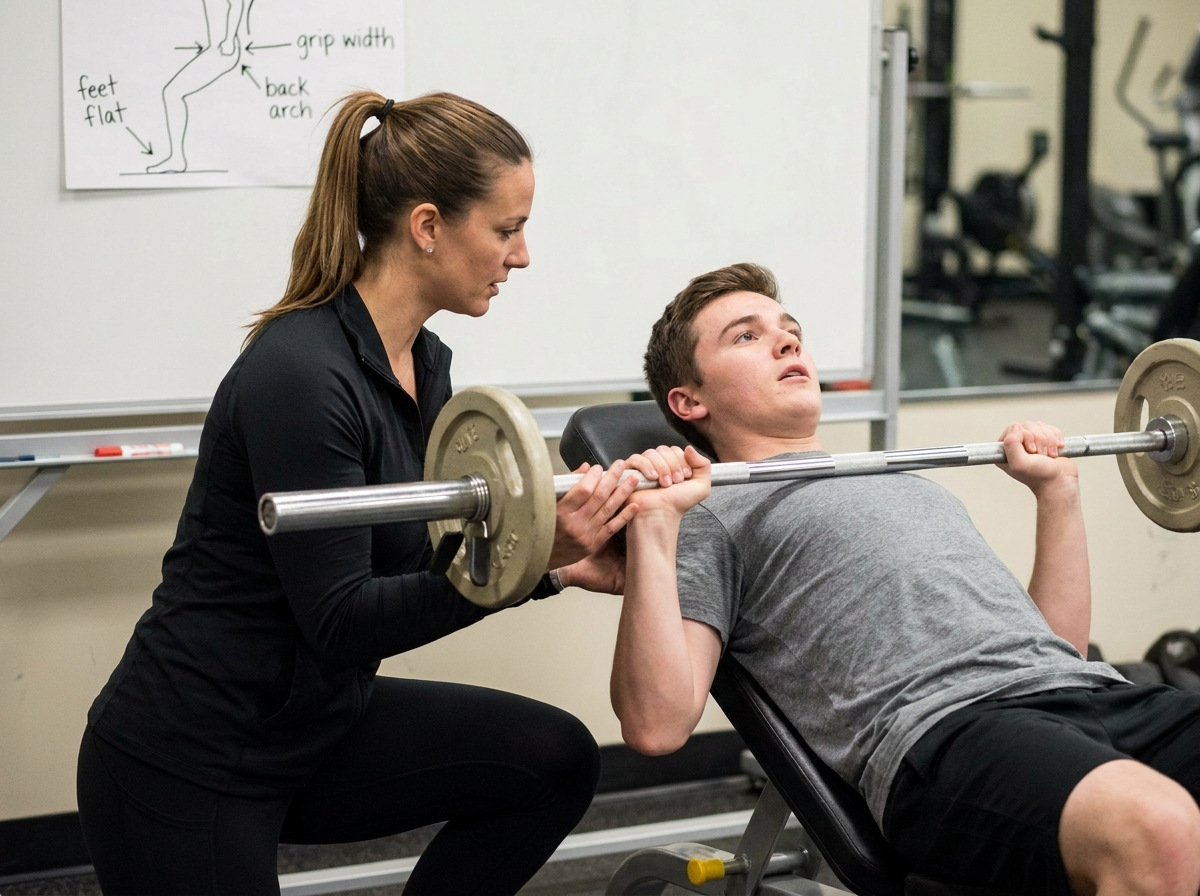
Position yourself on the bench. Lie back so your eyes are directly under the bar. Plant your feet flat on the floor, hip-width apart, with your shins roughly vertical. Press your upper back and glutes into the bench.
-
Retract and depress your scapulae. Pull your shoulder blades together and push them down toward your hips. You should feel your chest rise slightly. Hold this position for the entire set.
-
Grip the bar. Place the bar at the base of your palm, not across your fingers. The elbows should either be slightly inside or directly in line with the barbell when the weight is on the chest. This position is the most optimal way to transfer force from the shoulder girdle, through the arms, and to the barbell. Wrap your thumb around the bar fully — never use a thumbless grip on a loaded barbell.
-
Unrack with control. Take a breath, brace your core, and push the bar straight up out of the hooks. Move it forward until it's positioned directly above your lower chest. Do not begin descending from over your face.
-
Lower the bar with intention. Inhale and take 2 to 3 seconds to lower the bar along a slight diagonal to your lower chest or upper abdomen. Keep your elbows at roughly 45 to 60 degrees from your torso — not flared out at 90 degrees and not clamped tight to your sides.
-
Drive the bar up and back. Touch the bar lightly to your chest, exhale, and press it upward and slightly back toward your face. Squeeze your chest and think about pushing yourself into the bench rather than just pushing the bar up.
-
Re-rack deliberately. Guide the bar back into the hooks with controlled movement. Never drop it onto the uprights with momentum.
Start with an empty barbell or a very light load. Due to individual factors, there is no single best technique for this lift. Though certified personal instruction is best, general guidelines may help reduce some of the risks. Use your early sessions to drill the movement pattern, not to find your maximum.
For a structured approach to adding weight over time, check out progressive overload methods for muscle growth once your form is consistent.
Common Bench Press Mistakes to Fix Immediately
Even with good intentions, these errors appear in almost every beginner. Catching them early costs you nothing. Letting them stick costs you months.
Elbows flaring to 90 degrees. This is the most widespread error among new lifters. When the elbow flares out laterally, the shoulder moves into internal rotation, which puts the shoulder at a biomechanical disadvantage and at higher risk for injury. This is coupled with slight shoulder elevation and abduction, putting the athlete at further risk for impingement. The fix: lower your elbows to 45 to 60 degrees from your torso and adjust your grip width until the forearms stay perpendicular to the bar at the bottom.
Losing scapular position mid-set. You set up beautifully, then let your shoulder blades spread apart as the weight gets heavy. This collapses your stable base and dumps stress onto the rotator cuff. Film yourself from the side or ask someone to watch your upper back during the set.
Bouncing the bar off your chest. Using momentum to restart a stalled rep bypasses the pressing muscles and risks rib injury. Control the descent, make contact, and press from a dead stop or a light touch.
Gripping too wide. A wider grip feels more powerful at first because it shortens the range of motion. But research consistently shows it significantly elevates shoulder load. If your hands are approaching the smooth-to-knurling boundary on a standard barbell, bring them in.
Neglecting spotter technique. A spotter's job isn't to deadlift the bar off your chest — it's to guide a nearly-complete rep to the top. Agree beforehand on a signal word for assistance, and use a power rack with safety bars when training alone. Never bench to failure without one or the other.
Beyond the bench, these same principles apply to other foundational lifts. Reviewing common lifting mistakes beginners make at the gym will reinforce the patterns you're building here.
Summary and Next Steps
Getting how to bench press correctly for beginners right comes down to three non-negotiables: a safe grip width at or below 1.5 times your biacromial width, active scapular retraction throughout every rep, and a bar path that descends diagonally to your lower chest and presses back up in a slight arc. These three mechanics together protect your shoulders, maximize chest activation, and build the strength foundation you can load progressively for years.
Start light, film your sets from the side, and prioritize the setup checklist over the weight on the bar. Once your movement pattern is clean, Sculpt AI can take it from there: the app builds your bench press program around your current strength level, tells you the exact weight to target each session for progressive overload, calculates your 1RM after every workout, and tracks your personal records automatically so you always know you're moving in the right direction.
Sources
- Noteboom, L. et al. (2024). Effects of bench press technique variations on musculoskeletal shoulder loads and potential injury risk. Frontiers in Physiology
- Green, C.M. & Comfort, P. (2007). The affect of grip width on bench press performance and risk of injury. Strength & Conditioning Journal / ResearchGate
- Nuckols, G. (2020). Bench press bar path: How to fix your bar path for a bigger bench. Stronger by Science
- McGuire, L. (2018). How to fix an elbow flare. Girls Who Powerlift
- Williams, D. Bench press — mechanics and scapulo-humeral rhythm. Range of Motion
Keep going
Related tools on Sculpt
About this article

Written by
Dylan MartinezContent & Community at Sculpt
Dylan leads content and community at Sculpt, including editorial direction for the Sculpt research library.