How to Build a Healthy Plate From Scratch as a Complete Beginner
Not sure what belongs on your plate or how much? This beginner meal composition guide breaks down every section of a balanced meal in plain language.
How to Build a Healthy Plate for Beginners Without Overcomplicating It
If you have ever stood in your kitchen genuinely unsure what to put on your plate, you are not alone. Nutrition can feel overwhelming when you are starting out, but learning how to build a healthy plate for beginners does not require a degree in dietetics. This guide delivers a clear framework for what a balanced meal looks like, how to portion food correctly, and why the specific arrangement of your plate affects energy, muscle growth, and long-term health. By the end, you will know exactly what goes in each section of your plate and why.
The real barrier for most beginners is not motivation — it is structure. Without a mental blueprint for meal composition, it is easy to default to whatever is fast or familiar. That is what this guide fixes. You will get the science behind macronutrient balance, a practical step-by-step plate-building method, and the most common beginner pitfalls to sidestep immediately.
What a Balanced Meal Actually Looks Like: The Science Behind the Plate
Before touching a single piece of food, you need a conceptual map. The most widely referenced framework for this is the USDA's MyPlate model, a visual guide built on the Dietary Guidelines for Americans that translates nutritional science into a simple plate diagram.
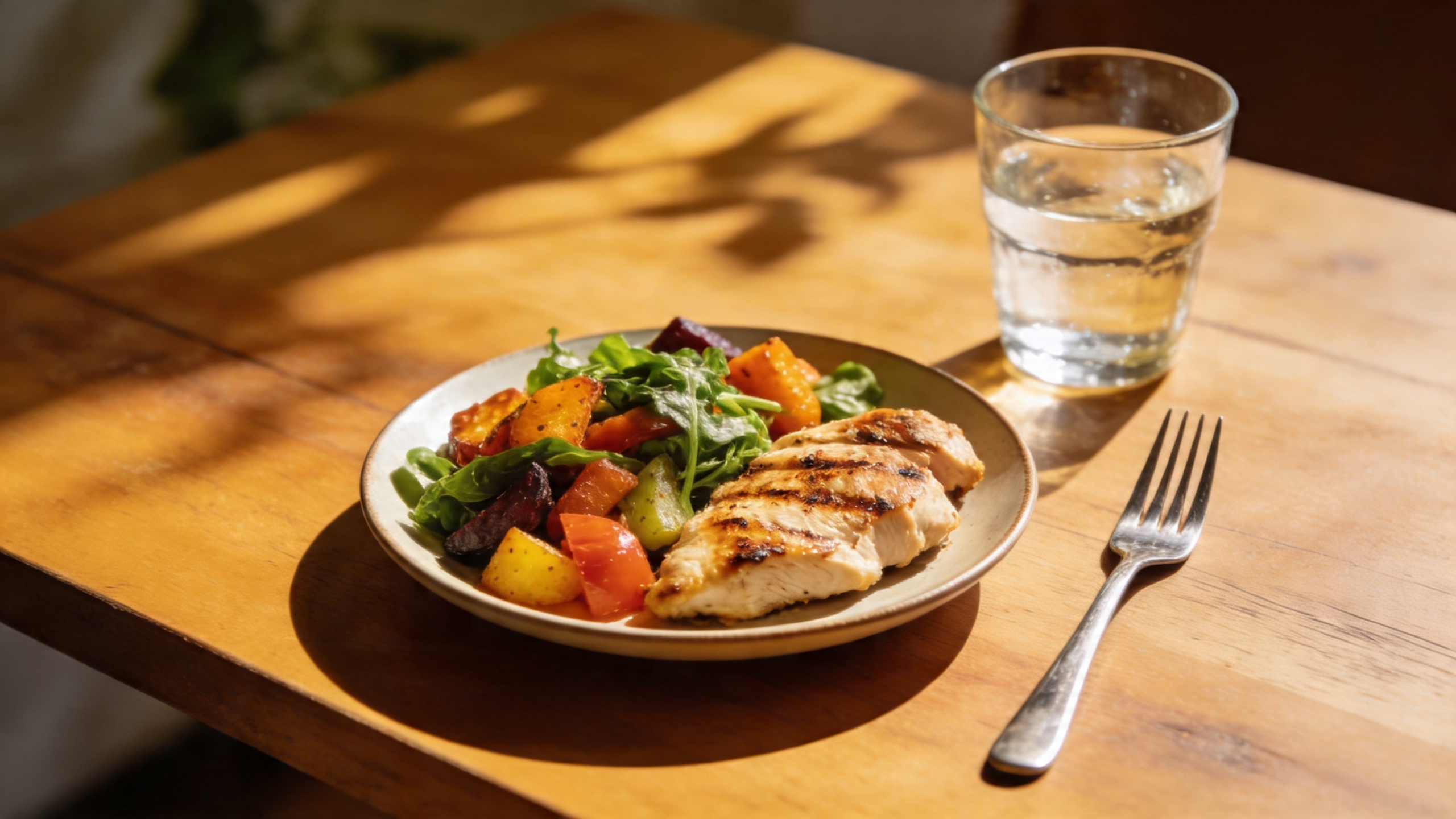
According to USDA MyPlate recommendations, about one-half of your plate should be filled with vegetables and fruit, about one-quarter should contain grains (with at least half of those being whole grains), and about one-quarter should contain lean protein. A small serving of dairy or a fortified plant-based alternative accompanies the plate on the side.
Why this specific split? Because each section serves a distinct biological function.
-
Vegetables and fruit (half the plate): Fruits and vegetables should fill one-half of your plate because of their potential health benefits and vital nutrients, including dietary fiber, potassium, folate, vitamin A, and vitamin C. Fiber is particularly important. Research has shown that increasing fiber intake can reduce the risk of various chronic diseases, such as cardiovascular disease, type II diabetes, obesity, colon cancer, and inflammation.
-
Grains (one quarter): The grains subgroup encourages whole grains, which provide more fiber, magnesium, and zinc than refined grains. Whole grains also deliver sustained energy release, which matters more the harder you train.
-
Protein (one quarter): The protein group includes meat, poultry, seafood, beans and peas, eggs, processed soy products, nuts, and seeds, and should make up no more than one-quarter of your plate.
How Protein Distribution Affects Your Results
Where you place protein on the plate matters, but so does when you eat it across the day. The consumption of a moderate amount of protein at each meal stimulates 24-hour muscle protein synthesis more effectively than skewing protein intake toward the evening meal. Research published in the Journal of the International Society of Sports Nutrition suggests that muscle protein synthesis is maximized in young adults with an intake of approximately 20–25g of a high-quality protein per meal, consistent with the "muscle full" concept; anything above this amount is believed to be oxidized for energy or converted to other compounds.
This means front-loading all your protein at dinner is not an efficient strategy. Spreading it across three or four meals gives your muscles a consistent supply of amino acids throughout the day.
Understanding this connects directly to how to understand macronutrients and why they matter for your health — the macronutrient balance across your day shapes your recovery, energy levels, and body composition simultaneously.
Healthy Plate Portions Explained: How to Build Your Plate Step by Step
Theory is useful. A repeatable process is better. Here is a beginner meal composition guide you can follow for every meal.
Step 1: Fill Half the Plate with Vegetables First
Start with the biggest section. Pile on non-starchy vegetables like spinach, broccoli, peppers, courgette, or tomatoes. These are low in calories and high in micronutrients, so there is virtually no upper limit to how generously you fill this section. If you want some fruit on the same plate — a handful of berries alongside eggs at breakfast, for example — that counts toward this half too.
Step 2: Add a Quarter Plate of Quality Protein
Choose one primary protein source per meal. Lean options include:
- Grilled chicken breast or turkey
- Salmon, tuna, or another oily fish (at least twice a week for omega-3s)
- Eggs or egg whites
- Greek yogurt (also counts toward dairy)
- Legumes like lentils, black beans, or chickpeas (these double as a carb source too)
- Tofu or tempeh
Aim for a portion roughly the size of your palm. For most adults, this translates to around 100–150g of cooked meat or fish, or a cup of cooked legumes.
Step 3: Fill the Remaining Quarter with Whole Grains or Complex Carbs
At least half of your grains should be whole grains. Practical options include brown rice, quinoa, oats, whole-wheat bread, or sweet potato. These carbohydrates provide the glucose your brain and muscles rely on for fuel, especially on training days. If you want to understand how carbohydrate choices affect your energy, the article on how carbohydrates affect energy levels for gym beginners goes deeper on this.
Step 4: Add a Small Amount of Healthy Fat
Fat does not need its own plate section, but it should appear somewhere in the meal. A drizzle of olive oil on your vegetables, half an avocado, a small handful of nuts, or a tablespoon of nut butter adds essential fatty acids and helps your body absorb fat-soluble vitamins A, D, E, and K. Keep the portion small. Fat is calorie-dense, and a thumb-sized portion is usually enough.
Step 5: Pair with a Dairy or Fortified Alternative
Calcium-fortified soy milk and yogurt are recognized within the dairy group and are suitable for those embracing a plant-based lifestyle while providing essential nutrients. A glass of low-fat milk, a small pot of Greek yogurt, or a serving of cottage cheese covers calcium, vitamin D, and additional protein without disrupting the rest of the plate.
| Plate Section | Food Examples | Approximate Portion |
|---|---|---|
| Vegetables and fruit | Spinach, peppers, tomatoes, berries | Half the plate |
| Lean protein | Chicken, salmon, eggs, lentils | Palm-sized / ~100–150g cooked |
| Whole grains / carbs | Brown rice, oats, sweet potato, quinoa | Quarter of the plate |
| Healthy fats | Olive oil, avocado, nuts | Thumb-sized |
| Dairy or alternative | Low-fat yogurt, milk, fortified soy | 1 cup / small pot |
Common Mistakes Beginners Make When Building Their Plate
Knowing the framework is only half the job. Understanding where most people go wrong will save you weeks of frustration.
Skipping vegetables to save time. This is the single most common error. Vegetables are the foundation of a balanced diet for beginners — they fill volume, slow digestion, and supply micronutrients that support everything from immune function to muscle recovery. If you struggle to eat them consistently, check out the practical strategies in how to eat more fruits and vegetables every day without getting bored.
Loading too much protein and not enough carbs on training days. Protein gets all the attention, but carbohydrates are your primary fuel source during gym sessions. Cutting them too aggressively leads to flat, low-energy workouts. The quarter-plate carb rule exists for a reason. On heavy training days, you can slightly increase that portion — a larger scoop of rice or an extra slice of whole-grain bread — without derailing your goals.
Treating "healthy" as a free pass on portion size. Olive oil, nuts, avocado, and whole grains are all nutritious, but calories still count. The MyPlate guidelines recommend portion control while still enjoying food, as well as reductions in sodium and sugar intakes. A tablespoon of olive oil is healthy. Four tablespoons poured over a salad without thinking adds roughly 480 calories. Use the hand-portion method described above until your eye adjusts to realistic amounts.
Ignoring meal balance across the day. Understanding that every meal or snack will not contain every food group is essential. MyPlate encourages including at least three of the five food groups in each meal or snack to meet daily nutrient needs. If one meal is lighter on a particular group, compensate at the next one — rather than treating each meal as isolated from the rest of the day.
How to Build a Healthy Plate for Beginners: Putting It All Together
The core rules are simpler than most nutrition content makes them appear. Fill half your plate with vegetables and fruit. Add a palm-sized portion of quality protein. Use a quarter of the plate for whole grains or complex carbs. Include a small serving of healthy fat and a dairy or fortified alternative on the side. Repeat, adjust, and get consistent.
Three things to focus on first: get vegetables on every plate, spread protein across meals rather than loading it at dinner, and choose whole grains over refined ones wherever you can. These three shifts alone will produce measurable changes in energy and body composition over time. Once your plate structure feels automatic, explore how to control portion sizes without weighing every meal to refine your approach further.
Sculpt AI makes this even more practical. Once your plate is built, you can open the app and simply tell it what you ate — "chicken breast, brown rice, broccoli, olive oil" — and it logs the calories, protein, carbs, and fat instantly without any menu tapping. Point your camera at your plate and the app reads the macros automatically. You will see your daily totals against your personal targets at a glance, calculated from your actual stats and training frequency, not a generic formula. If you are serious about building better meals consistently, Sculpt turns plate knowledge into trackable progress.
Sources
- U.S. Department of Agriculture (2024). What Is MyPlate? USDA MyPlate
- ScienceDirect / Safeway Health Blog (2025). MyPlate Food Groups: The Ultimate Guide to Pursuing Balanced Nutrition. Safeway Health
- ScienceDirect Topics (2023). MyPlate — an overview. ScienceDirect
- Mamerow MM, et al. (2014). Dietary Protein Distribution Positively Influences 24-h Muscle Protein Synthesis in Healthy Adults. ScienceDirect / Journal of Nutrition
- Schoenfeld BJ, Aragon AA (2018). How much protein can the body use in a single meal for muscle-building? Implications for daily protein distribution. PMC / Journal of the International Society of Sports Nutrition
- UMass Memorial Health (2025). Understanding USDA MyPlate. UMass Memorial Health
- Wikipedia (2026). MyPlate. Wikipedia
- Clemson University Land-Grant Press (2024). MyPlate: A Guide to Healthier Eating. Clemson University
- National Center for Health Research (2021). MyPlate: Understanding the Dietary Guidelines for Americans. Center4Research
- Ullah R, et al. (2024). Dietary fiber influence on overall health, with an emphasis on CVD, diabetes, obesity, colon cancer, and inflammation. PMC / Frontiers in Nutrition
- USDA (2017). Back to Basics: All About MyPlate Food Groups. USDA.gov
Keep going
Related tools on Sculpt
About this article

Written by
Dylan MartinezContent & Community at Sculpt
Dylan leads content and community at Sculpt, including editorial direction for the Sculpt research library.