Calorie Counting vs Intuitive Eating: Which Approach Is Right for a Beginner
Torn between logging every meal and just eating what feels right? Here is what the research actually says about calorie counting vs intuitive eating for beginners.
Calorie Counting vs Intuitive Eating for Beginners: What Should You Actually Do?
You just started training. Now you are staring down two completely opposite pieces of advice: obsessively log every gram you eat, or ditch the numbers and "listen to your body." The debate around calorie counting vs intuitive eating for beginners can feel paralyzing when you have no idea which camp is right for your goals. This article cuts through the noise. You will learn how each approach works mechanically, what the research says about their outcomes, and how to decide which strategy gives you the best starting point.
Why Both Approaches Exist and What Each One Actually Does
Neither calorie counting nor intuitive eating appeared out of nowhere. Each one addresses a real problem with the other.
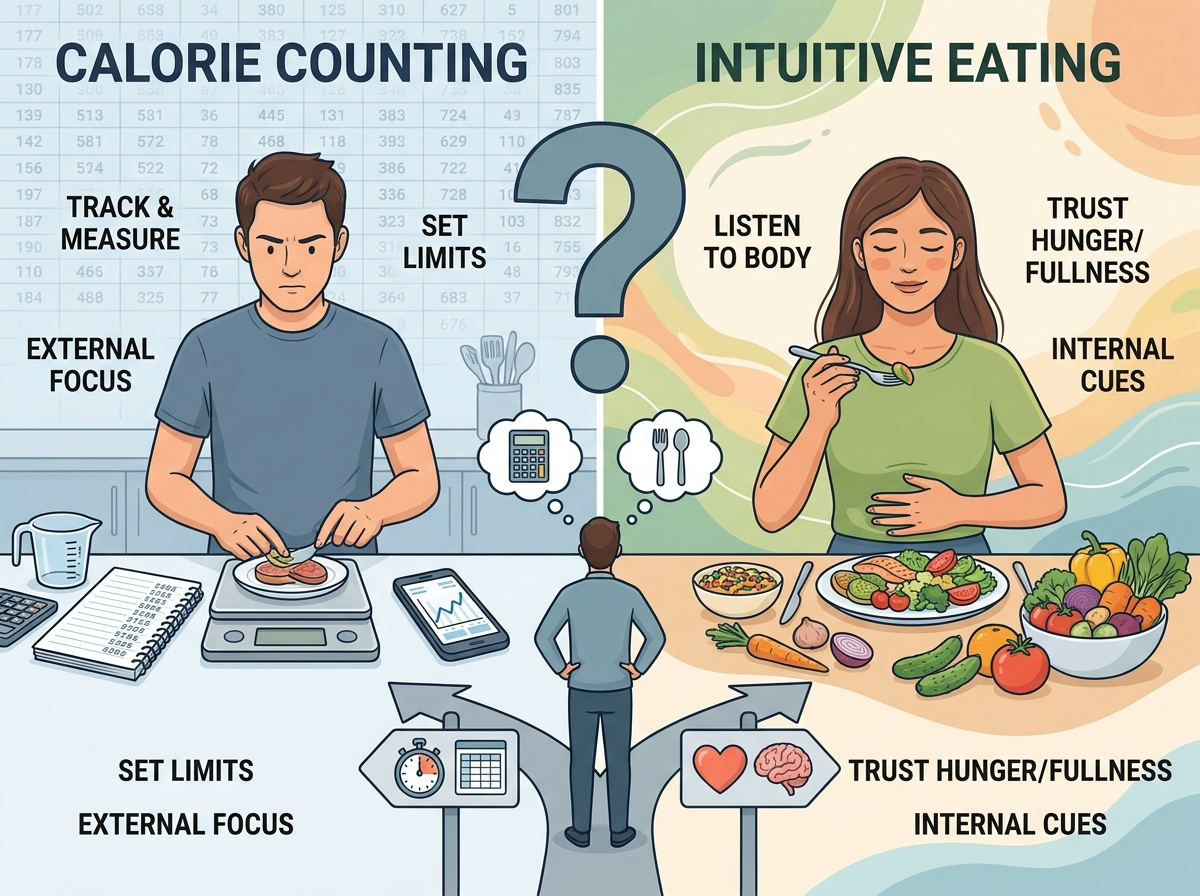
Calorie counting works by giving you a concrete number to aim for. You calculate your total daily energy expenditure (if you are new to that concept, check out what TDEE is and how to use it to hit your body goals), then eat slightly above or below that number depending on whether you want to gain muscle or lose fat. The appeal is precision. You know exactly where you stand at the end of the day. Research backs the method: individuals who consistently tracked five or more days per week were successful in losing and sustaining weight loss over the course of a year , according to a study published in Obesity examining dietary tracking adherence over 49 weeks.
The catch is accuracy. There is a large inter-individual range in errors when estimating food calories, ranging from 760 kcal underestimation to 468 kcal overestimation, and fewer than one in four adults can estimate calories in food with an error of less than 15%. That is a wide margin, especially when you are trying to maintain a precise deficit.
Intuitive eating (IE) takes the opposite view. It uses your body's own hunger and fullness cues as the primary guide for when and how much to eat, rather than a target number. Research has shown that IE can lead to greater psychological wellbeing, increased pleasure when eating, and body satisfaction. On the weight maintenance front, clinical studies conclude that the implementation of intuitive eating does not result in significant weight loss but may aid in weight maintenance, particularly over the long term, and in improved psychological health.
The limitation for beginners is that tuning in to genuine hunger and fullness cues requires practice. Research also shows that permission to eat all foods with no food rules can sometimes lead to unhealthful food choices with more high-calorie palatable foods, and therefore a certain level of restraint and nutrition knowledge may be beneficial when starting an IE plan.
The Problem With Pure Intuition at the Start
Here is the core issue for anyone brand new to fitness nutrition: your "intuition" is built on your existing habits. If those habits produced the results you wanted, you would not be here. Most people underreport how much they eat and underestimate calorie intake by 20 to 50 percent, making it harder to maintain a healthy weight. Trusting a system that is already miscalibrated produces miscalibrated results.
This does not make intuitive eating wrong. It makes it a skill you have to earn, not a starting point.
How to Decide: A Practical Framework for Beginners
The research does not declare one approach universally superior. What it does show is that each suits a different situation. Use the following framework to figure out where you currently stand.
Choose structured calorie tracking if you:
- Have a specific body composition goal with a timeline (cut, bulk, or recomp)
- Have no baseline sense of how many calories are in the foods you eat regularly
- Are new to tracking macros and protein targets
- Want data-driven feedback so you can adjust when progress stalls
Choose intuitive eating as your primary approach if you:
- Have a history of disordered eating or obsessive food anxiety
- Have already spent time tracking and understand what a reasonable portion looks like
- Want a sustainable, long-term framework rather than a short-term intervention
- Are focused more on building a healthy relationship with food than hitting a specific number
The hybrid approach most beginners benefit from:
- Track calories and protein precisely for six to twelve weeks using a food scale and a reliable app.
- Use that phase to learn what your actual portions look like, which foods are calorie-dense, and how your body responds to different intake levels.
- Gradually reduce logging frequency while maintaining the nutritional awareness you built.
- Shift toward using hunger and fullness cues as your primary guide, with periodic check-ins via tracking if progress stalls.
When mindful or intuitive eating is combined with a method such as tracking hand portions, calories, or macros, you get external guidelines to help you become more aware and make better choices, and you learn to better self-regulate your intake by paying attention to how food makes you feel.
This combined strategy is particularly useful for gym beginners who also need to hit a protein target to build muscle. Protein targets are concrete numbers. Intuition alone rarely gets you there when you are starting from zero nutritional awareness.
Common Mistakes That Undermine Both Approaches
Switching between approaches without purpose is the biggest trap. You track for two weeks, feel restricted, quit and go fully intuitive, overeat because you have no reference point, then go back to tracking. The cycle burns energy and produces nothing.
Mistakes beginners make with calorie counting:
- Logging food from memory at the end of the day instead of in real time. Memory-based logging inflates estimation errors significantly.
- Skipping liquid calories. A large latte, a juice, and a protein shake can easily add 500 or more calories that never make it into the log.
- Treating the app number as gospel. Calorie databases have real inaccuracies. Your job is to look for trends in your body weight over two to three weeks, not to trust a single day's number.
- Allowing the numbers to create anxiety around food. The focus on numbers and strict tracking can end up in obsessive behaviours, such as constantly checking calorie counts, fear of eating certain foods, or guilt when surpassing daily limits. If that describes you, structured tracking may not be the right entry point.
Mistakes beginners make with intuitive eating:
- Confusing emotional hunger with physical hunger. Boredom, stress, and habit are not the same signals as genuine physiological need. Learning to distinguish between them takes active practice.
- Starting intuitive eating with no nutritional foundation. Without knowing roughly how much protein, carbohydrate, and fat your meals contain, you are flying blind on the information that matters most for your training goals.
- Expecting intuitive eating to produce fast fat loss. A meta-analysis of 10 randomised controlled trials found that mindful and intuitive eating strategies were effective for weight loss compared with no intervention, but there was no difference in weight reduction compared with conventional weight loss programs. It works, but the timeline is slower and requires genuine consistency.
Summary and Next Steps
Calorie counting vs intuitive eating for beginners is not a binary choice. Both tools have a place in a well-structured nutrition approach. Tracking gives you the data literacy you need to make informed choices. Intuitive eating gives you the sustainable habits you need to stick with those choices for years, not just weeks. For most beginners, six to twelve weeks of tracking followed by a gradual transition toward intuitive eating is the most practical path.
Start with your numbers, build your awareness, then trust what you have learned. If you want to understand how your training load affects what you should eat, read up on how to create a calorie deficit without losing muscle as a natural next step.
Sculpt AI makes the tracking phase far less painful. You can tell the AI "I had grilled chicken and rice" and it logs the meal instantly, no manual entry required. Point your phone camera at a nutrition label or a plate and Sculpt reads the macros automatically. The app calculates your actual TDEE based on your stats and training frequency, not a generic formula, so your calorie target is calibrated to you from day one. As you build confidence and shift toward more intuitive eating, Sculpt's body weight trend line helps you see whether your instincts are on target without the stress of logging every bite. Download Sculpt and use the tracking phase to learn your numbers properly, so that when you eventually eat by feel, you are doing it from a position of real knowledge.
Sources
- Laskowski, E. et al. (2017). The Effect of Adherence to Dietary Tracking on Weight Loss: Using HLM to Model Weight Loss over Time. PMC / Obesity
- Dooley, E. et al. (2016). Calorie Estimation in Adults Differing in Body Weight Class and Weight Loss Status. PMC / PLOS ONE
- Harvard T.H. Chan School of Public Health (2024). Intuitive Eating. The Nutrition Source
- Van Dyke, N. & Drinkwater, E.J. (2014). Relationships between intuitive eating and health indicators: literature review. Cambridge Core / Public Health Nutrition
- Hazzard, V.M. et al. (2020). Intuitive Eating Longitudinally Predicts Better Psychological Health and Lower Use of Disordered Eating Behaviors. PMC
- Precision Nutrition (2021). Macros vs. Calories vs. Intuitive Eating: What's Best? Precision Nutrition
- Carter, K. (2021). Why We Underestimate What We Eat. Psychology Today
Keep going
Related tools on Sculpt
About this article

Written by
Dylan MartinezContent & Community at Sculpt
Dylan leads content and community at Sculpt, including editorial direction for the Sculpt research library.