What Are the Five Food Groups and Why Every Beginner Needs to Know Them
The five food groups are your nutrition foundation. Learn what they are, why each one matters, and how to use them to build a healthier plate starting today.
Five Food Groups Explained for Beginners: Why This Is Your Starting Point
If you have just started taking nutrition seriously, you have probably hit a wall of conflicting advice: eat keto, try intermittent fasting, count every macro. Before you do any of that, you need a map. The five food groups explained for beginners is that map, and this article will show you exactly what those groups are, why each one pulls its weight, and how to apply the framework to real meals today. You will also learn the three most common beginner mistakes that quietly undermine an otherwise solid diet.
Most confusion around eating comes from focusing on individual nutrients in isolation. Food group thinking fixes that. Food groups simplify dietary recommendations by focusing on foods instead of nutrients. That means you can stop obsessing over hitting 75 milligrams of vitamin C and simply aim to eat more fruit. It is a practical shift that makes nutritional completeness achievable on a busy schedule.
What Are the Main Food Groups and What Does Each One Do?
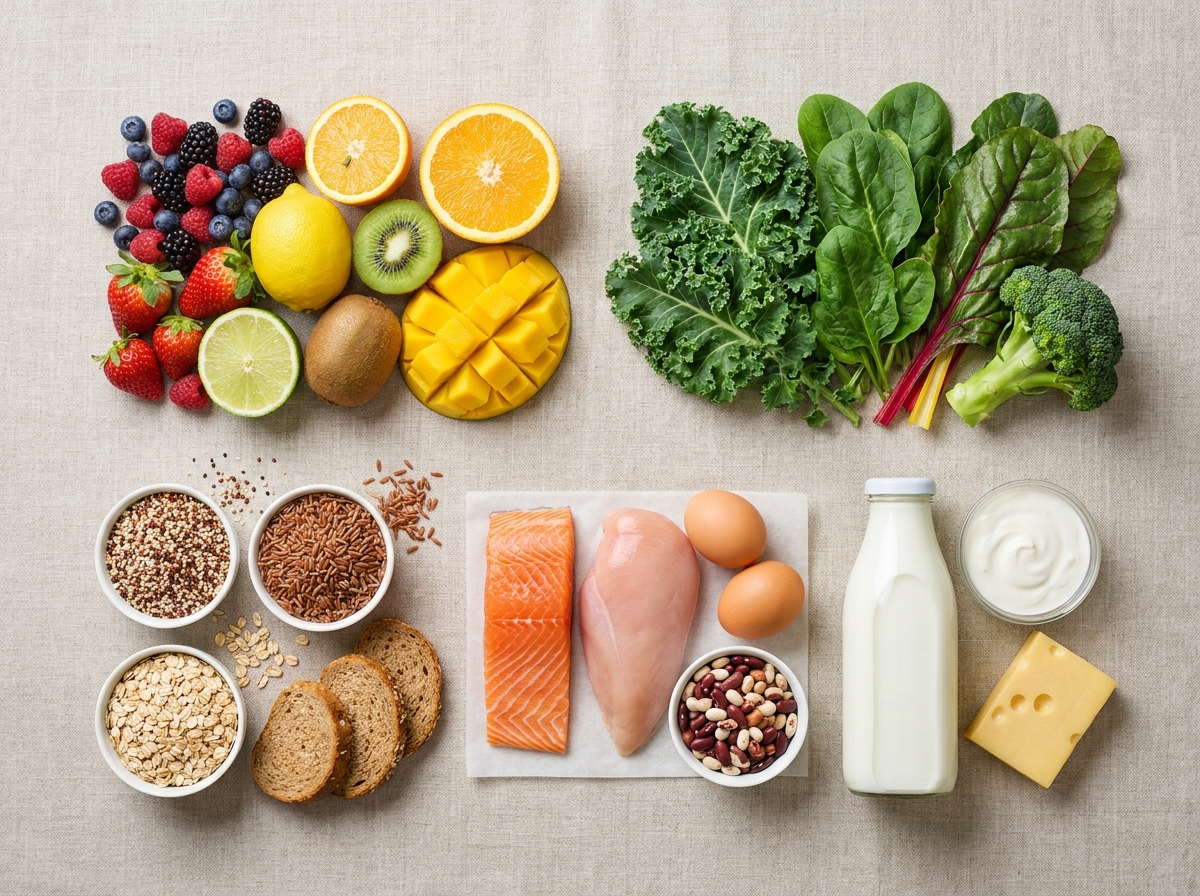
The five food groups, as shown by the USDA MyPlate icon, are Fruits, Vegetables, Grains, Protein Foods, and Dairy.
Created in 2011 by the U.S. Department of Agriculture, MyPlate is designed to help people make healthy, balanced food choices that align with the Dietary Guidelines for Americans. Think of these five groups as five different supply chains, each delivering a unique payload of nutrients your body needs to function, recover, and stay healthy.
Fruits and Vegetables
These two groups earn the biggest real estate on your plate for good reason. MyPlate recommends that fruits and vegetables together fill one-half of your plate because of their potential health benefits and vital nutrients, including dietary fiber, potassium, folate, vitamin A, and vitamin C. Dietary variety within this group matters just as much as quantity. Higher dietary diversity scores are associated with increased fiber, fruit, and vegetable intake, greater meal frequency, and lower ultra-processed food consumption.
Practical note: fresh, frozen, and canned options all count. You do not need an expensive grocery run to hit your targets.
Grains
Grains supply carbohydrates, your body's primary energy currency, along with B vitamins and fiber. The key distinction is whole grains versus refined grains. From 2005 to 2025, the U.S. Dietary Guidelines recommended that all Americans make at least half of their grains whole grains. Whole grains retain the bran and germ, which means they deliver fiber and micronutrients that refined versions lose during processing. Whole grains provide fiber, vitamins, minerals, and other nutrients, and help control cholesterol levels, weight, and blood pressure, while also helping to lower the risk of diabetes and heart disease.
Check out the full breakdown of whole grains vs refined grains and what the difference means for your body.
Protein Foods
This group does the structural work. The primary function of dietary protein is to build and repair cells, including the muscle cells damaged when exercising to the point of momentary fatigue. If you are training at the gym, getting adequate protein from this group directly determines how well you recover between sessions. Emerging evidence demonstrates a promising role for whole food protein sources as an effective nutritional strategy to support muscle protein remodeling and recovery after exercise.
MyPlate does not include meat as the sole member of the protein food group; instead, the category includes fish, shellfish, eggs, beans, peas, nuts, seeds, and soy products, in addition to meat. That breadth matters, because it makes the group accessible whether you eat meat every day or follow a plant-based diet.
Dairy
The dairy group is primarily your source of calcium and vitamin D. The latest USDA guidelines include fortified soy alternatives in the dairy category , so this group is not exclusive to those who tolerate lactose. Calcium supports bone density, which is especially important for younger adults still in their peak bone-building years. If you want more detail on navigating this group without traditional dairy, read how to meet your dairy nutritional needs whether you eat dairy or not.
Why Food Group Categories Matter Beyond Just Eating "Healthy"
By eating recommended amounts from each group, individuals can meet their nutritional needs without having to track dozens of individual nutrients. That is the real power of this food classification system. It shifts the cognitive load from micromanaging numbers to building a balanced plate by visual proportion. For a beginner, that mental simplicity is what keeps healthy habits consistent over weeks and months.
How to Use This Food Classification Guide in Practice
Understanding food groups is step one. Applying them to how you actually shop, cook, and eat is where the real work happens. Here is a straightforward framework.
Build your plate using proportions, not perfection.
- Fill half your plate with fruits and vegetables. Rotate your choices during the week. Spinach on Monday, broccoli on Wednesday, a banana with breakfast every day. Variety within groups drives nutrient density.
- Fill one quarter of your plate with grains. Prioritize whole grain sources: oats, brown rice, whole wheat bread, quinoa. Check ingredient labels; the first ingredient should list a whole grain.
- Fill the remaining quarter with protein foods. Rotate sources. Chicken breast, canned salmon, lentils, eggs, and Greek yogurt all qualify. Rotating sources keeps your amino acid and micronutrient intake broader.
- Add a serving of dairy or a fortified alternative on the side. A glass of milk, a container of low-fat yogurt, or calcium-fortified soy milk all count.
- Adjust portions to your calorie needs. MyPlate daily food group targets are based on a 2,000-calorie plan, but nutrition needs vary based on your age, sex, height, weight, physical activity level, and health conditions. A person training five days per week needs more fuel than someone living a sedentary lifestyle.
Read labels when choosing packaged grain products. Ingredients on a food label are listed from greatest to least amount, and the words "whole grain" should appear at the beginning of the ingredient list. If you see "enriched wheat flour" before any whole grain ingredient, the product is mostly refined.
Treat the protein group as flexible. If your protein source rotates between animal and plant options, you will naturally cover a wider range of essential amino acids and micronutrients. Beans and lentils also count toward your vegetable subgroup as legumes, making them double-duty ingredients. For gym beginners particularly focused on building muscle, it helps to understand how much protein you should eat to build muscle alongside this food group framework.
Common Mistakes That Undermine Understanding Food Groups Nutrition
Mistake 1: Treating all food in a group as equally nutritious.
Not every item in a group delivers the same nutrient density. White bread belongs to the grains group. So does oatmeal. Fruit-flavored yogurt belongs to the dairy group. So does plain Greek yogurt with far less added sugar. The food group system tells you what category a food belongs to. It does not guarantee that every item in that category is a good choice. Within each group, prioritize whole foods with minimal added sugar, saturated fat, and sodium. By eating unprocessed, nutrient-dense foods and limiting sugars and saturated fats, people at any age can begin forming healthy eating patterns.
Mistake 2: Skipping entire food groups because of a trend.
Low-carb diets pressure beginners to eliminate grains. Dairy-free trends lead people to skip the dairy group without replacing calcium elsewhere. Americans already underconsume fruits, vegetables, dairy, and whole grains compared with recommendations. Cutting entire groups from your diet without a deliberate plan to replace their nutrients makes this gap worse. If a food group genuinely does not fit your lifestyle (dairy is a common one), the solution is to find equivalents within that group's function, not to leave the nutrient gap empty. The five food group framework exists precisely because each group covers territory the others do not fully replicate.
Build Your Foundation, Then Track It
The five food groups explained for beginners gives you a practical, evidence-backed framework for nutritional completeness without the overwhelm of tracking every gram. The three core takeaways: fill half your plate with fruits and vegetables, choose whole grains at least half the time, and rotate your protein sources so your amino acid and micronutrient intake stays broad. Those three habits alone put you ahead of most beginners.
Once you understand the framework, the natural next step is seeing how it plays out against your actual goals. That is where Sculpt AI makes this actionable: simply tell the app what you ate and it logs every food group contribution automatically, no manual tapping required. Point your camera at a meal and Sculpt reads the macros instantly. You will see your calories, protein, carbs, and fat against your daily targets at a glance, so you always know which food groups you are hitting and which ones need attention. Understanding the five food groups is the map. Sculpt is the navigation system that keeps you on the route.
Sources
- U.S. Department of Agriculture (2022). Back to Basics: All About MyPlate Food Groups. USDA
- Safeway Health Blog (2025). MyPlate Food Groups: The Ultimate Guide to Pursuing Balanced Nutrition. Safeway
- National Center for Health Research (2021). MyPlate: Understanding the Dietary Guidelines for Americans. Center4Research
- Drewnowski, A., Dwyer, J., King, J. C., & Weaver, C. M. (2019). A proposed nutrient density score that includes food groups and nutrients to better align with dietary guidance. Nutrition Reviews, Oxford Academic
- Benvenuto, G., et al. (2023). Dietary Diversity and Its Association with Diet Quality and Health Status: Results from the I.Family Study. PMC
- Whole Grains Council (2025). U.S. Dietary Guidelines and Whole Grains. Whole Grains Council
- Mayo Clinic (2025). Whole grains: Hearty options for a healthy diet. Mayo Clinic
- Stokes, T., et al. (2018). Achieving Optimal Post-Exercise Muscle Protein Remodeling in Physically Active Adults through Whole Food Consumption. PMC
- American College of Exercise (2020). 9 Things to Know About How the Body Uses Protein to Repair Muscle Tissue. ACE Fitness
- Fussell, N. J., et al. (2023). Dietary Guidelines for Americans, 2020–2025: Understanding the Scientific Process, Guidelines, and Key Recommendations. PMC
Keep going
Related tools on Sculpt
About this article

Written by
Dylan MartinezContent & Community at Sculpt
Dylan leads content and community at Sculpt, including editorial direction for the Sculpt research library.