Free Weights vs Machines: What Should Beginners Focus On
Free weights or machines? The answer isn't as obvious as gym culture suggests. Here's what the science actually says for beginners.
Free Weights vs Machines for Beginners: Which Actually Gets Results?
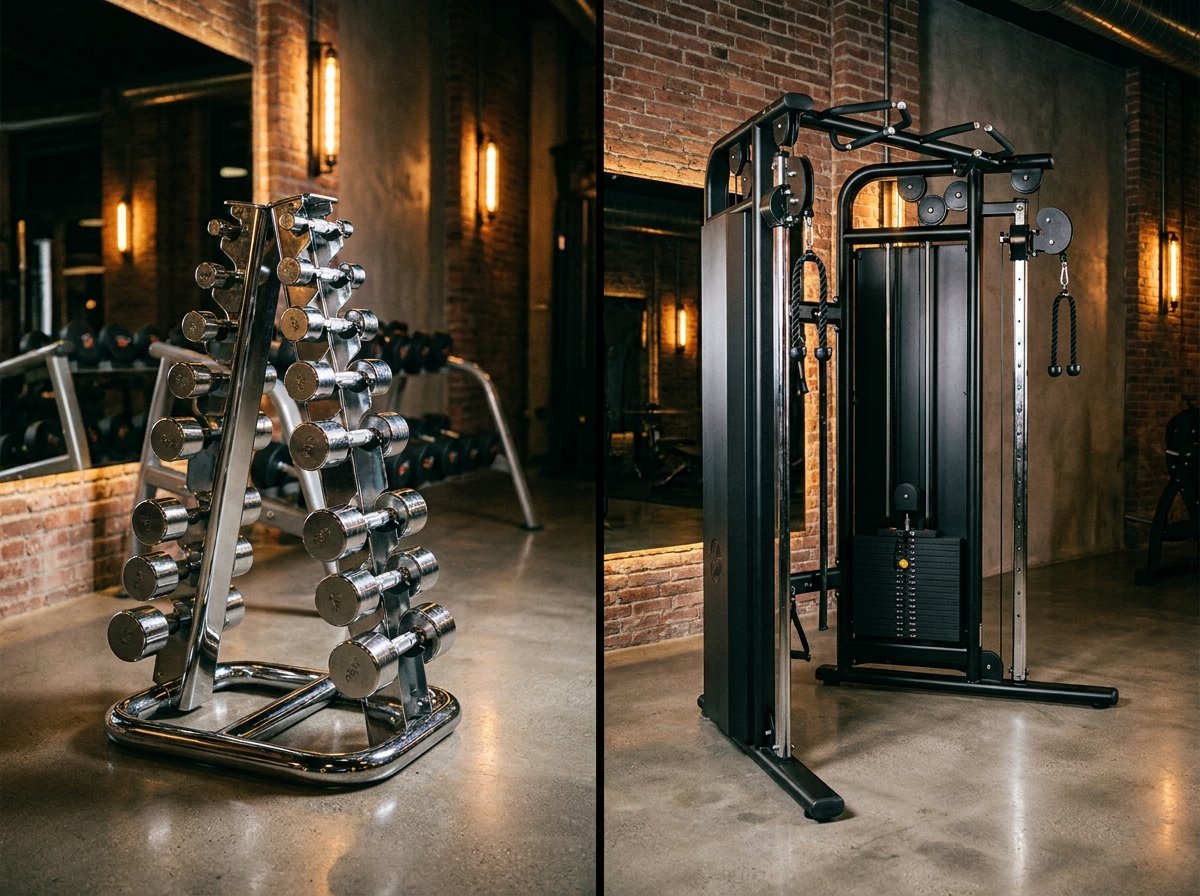
You walk into the gym for the first time and face two worlds: a rack of dumbbells and barbells on one side, a row of machines with adjustable seats and cable stacks on the other. The debate over free weights vs machines for beginners is one of the most common questions new lifters ask, and the answer matters because the choice you make shapes not just your first few sessions but your long-term progress. This article breaks down exactly what the research says, how each tool works in your body, and how to build a smart equipment strategy from session one.
The short answer: both work. The longer answer is where it gets useful.
What the Research Actually Says About Free Weights vs Machines for Beginners
The gym floor debate rarely matches what the science shows. The major finding from a published Journal of Strength and Conditioning Research study is that free weight and machine training were equally effective for increasing muscle thickness and strength. That is a direct, controlled result, and it holds up at scale too.
A 2023 systematic review and meta-analysis published in BMC Sports Science, Medicine and Rehabilitation pulled together 13 studies with a combined sample of 1,016 participants. No differences were found between modalities in direct comparison for dynamic strength, isometric strength, countermovement jump, or hypertrophy.
The current body of evidence indicates that strength changes are specific to the training modality, and the choice between free weights and machines comes down to individual preferences and goals.
That specificity point matters practically. If you train on machines, your machine-based strength improves most. If you train with free weights, your barbell and dumbbell strength improves most. Neither modality magically transfers better to everyday life than consistent, progressive effort.
The Real Mechanical Difference
The distinction that does matter for beginners is how each tool loads your body. A major difference between training with free weights and machines is that training with most machines provides a very stable environment, whereas training with free weights requires more stabilisation and balance, which may result in greater recruitment of muscle.
Using free weights compared with more stable machines results in greater muscle activation, as measured by electromyography, during both upper and lower body strength exercises. This is because free weights force your stabiliser muscles, the smaller muscles around your joints and through your core, to stay active throughout the lift. Machines guide you along a fixed movement path, which removes much of that coordination demand.
This is the core of the benefits of free weights for new lifters: you build proprioception and balance and coordination alongside the primary muscles from the very start. The catch is that this also makes the movements harder to learn, which is exactly why machines have a clear role too.
When to Use Machines at the Gym as a Beginner
Machines are not a shortcut for people who are afraid of real training. They are a legitimate tool with specific advantages, especially early on.
With machines, it is easier to feel which muscles are being activated because they work by isolating certain muscles or muscle groups. That is why beginners tend to benefit from machines, as well as learning mechanics using their body weight alone.
Here is a practical framework for how to use each tool:
Use machines when you want to:
- Isolate a specific muscle group without technique failure (leg press, lat pulldown, chest fly)
- Train to close to failure safely without a spotter
- Learn the feeling of a movement pattern before adding free-weight complexity
- Finish a session with targeted volume on fatigued muscles
Use free weights when you want to:
- Build compound strength through movements like squats, deadlifts, presses, and rows
- Train balance and coordination alongside muscle mass
- Develop functional strength that transfers to athletic and daily activities
- Progress systematically through small weight increments with dumbbells
If you include both in the same workout, start with free-weight exercises. Free weights usually engage more muscle groups. Starting with them allows you to fully use your energy and focus on maintaining proper form.
This sequencing matters. A barbell squat demands more from your nervous system and technique than a leg press. Hit it fresh. Once you have logged your compound work, machines are ideal for adding targeted isolation volume, think cable rows after pull-ups, or a chest press machine after your dumbbell bench work.
Pairing your sessions this way also means you never have to choose. The research cited above consistently shows that combining both modalities captures the strengths of each.
The Mistakes Beginners Make Choosing Between Equipment
The biggest trap new lifters fall into is treating this as an either/or decision permanently, rather than a context-dependent one.
Mistake 1: Only using machines because they feel safer. There is a lower learning curve with a machine compared to free weights. But that can also be a disadvantage, because it means you may not build skill in strength training the way you would with free weights. Spending months exclusively on machines means the first time you pick up a barbell, you are starting from scratch on movement patterns and proprioception.
Mistake 2: Jumping straight to heavy free weights without technique. The American College of Sports Medicine argues that machines may be safer to use than free weights based on skill requirements. Ego-loading a barbell squat before you understand the movement is one of the most reliable paths to injury. Master the pattern first with bodyweight or light dumbbells. You can read more about this in our guide on why proper form matters in weightlifting.
Mistake 3: Ignoring progressive overload on machines. Many beginners use the same weight on the cable stack every session. The muscle does not know what equipment you used; it only responds to progressive tension. Whether you are on a lat pulldown machine or doing dumbbell rows, you need to keep pushing the load over time. Our article on progressive overload methods for muscle growth covers this in detail.
Mistake 4: Treating dumbbells vs cable machines as a debate. Dumbbells and cables are both free weights in the functional sense; cables just provide constant tension through the range of motion. Use dumbbells for presses and rows, cables for flyes, pulldowns, and exercises that benefit from consistent resistance at the shortened position.
Build Your Beginner Plan Around Both Tools
The research is clear. Individuals looking to increase strength and power should consider the specificity of exercise and how their strength will be tested and applied. Individuals looking to increase general strength and muscle mass to maintain health may choose whichever activity they prefer and are more likely to adhere to.
That last point, adherence, is the one that separates the lifters who get results from the ones who quit in March. The best equipment choice is the one you actually show up for. Start with a mix: compound free-weight movements for your big lifts, machines for accessory work and isolation. Build the technique on the free-weight side progressively, and use machines to add volume safely. As your confidence grows on exercises like the squat, bench press, and deadlift, lean further into barbell vs machine training on the compound work.
Sculpt AI takes the guesswork out of this decision entirely. When you set up your profile, you tell the app your goals, your fitness level, and your gym setup. Sculpt then builds your program with the right mix of free weights and machines for where you are right now, including sets, reps, and target weights. If a piece of equipment is unavailable, the app swaps in an exercise that hits the same muscles. It also tracks your progressive overload session by session, so you always know exactly what weight to hit next, whether you are at the dumbbell rack or on a cable machine.
Sources
- Schwanbeck, SR, Cornish, SM, Barss, T, and Chilibeck, PD (2020). Effects of Training With Free Weights Versus Machines on Muscle Mass, Strength, Free Testosterone, and Free Cortisol Levels. Journal of Strength and Conditioning Research
- Haugen, ME et al. (2023). Effect of free-weight vs. machine-based strength training on maximal strength, hypertrophy and jump performance — a systematic review and meta-analysis. BMC Sports Science, Medicine and Rehabilitation
- Heidel KA, Novak ZJ, Dankel SJ (2021). Machines and free weight exercises: a systematic review and meta-analysis comparing changes in muscle size, strength, and power. PubMed
- Beelen, J et al. (2020). Using Machines or Free Weights for Resistance Training in Novice Males? A Randomized Parallel Trial. PMC / PubMed
Keep going
Related tools on Sculpt
About this article

Written by
Dylan MartinezContent & Community at Sculpt
Dylan leads content and community at Sculpt, including editorial direction for the Sculpt research library.