How to Set Realistic Gym Goals as a Beginner and Actually Hit Them
Most new gym-goers quit within months — not from lack of effort, but from setting the wrong goals. Here's how to build goals that stick from day one.
Why How to Set Realistic Gym Goals for Beginners Is the Question That Actually Matters
You joined the gym, you showed up, and now you're staring at a goal like "get in shape" with no idea what to do next. Understanding how to set realistic gym goals for beginners is the single most important step you can take before picking up a single weight. This article will show you why most beginner fitness goals fail within weeks, how a combination of the SMART framework and process-based thinking changes that, and exactly how to build and track goals that survive contact with real life.
The failure rate is not a myth. The failure rate for New Year's resolutions is estimated at 80%, with most people losing their resolve in mid-February. The cause is almost never laziness. This widespread drop-off is driven by unrealistic goals, lack of planning, and psychological factors such as motivation decay and decision fatigue. The fix is structural, not motivational.
The Science Behind Fitness Goal Setting for New Gym Goers
Motivation gets you through the door. Structure keeps you going back. Over four decades of research on goal setting in physical activity indicate that goal setting is an effective intervention strategy for behaviour change. But not all goals work equally well, and that distinction matters enormously for beginners.
The fitness world defaults to outcome goals: lose 10 kilograms, run a 5K, build visible abs. These targets feel motivating to write down. The problem is they are entirely results-dependent, often weeks or months away, and offer zero daily feedback. Long-term outcome goals are usually set for many weeks or months in the future, and as important as they are, they often lack the type of immediate feedback that people crave in order to feel success.
Process Goals: The Missing Layer
Process goals are the daily or weekly actions you control regardless of how your body responds on any given week. A process goal looks like: "attend the gym three times this week" or "complete all four sets of the program on Wednesday." Process goals refer to incremental steps, small successes, everyday habits, and necessary actions that an individual needs to perform in order to achieve their ultimate goal — smaller, more regularly occurring, and controllable goals provide a regular, recognizable feedback loop that behavioral experts suggest will drive motivation.
The performance data backs this up decisively. A systematic review published in the Journal of Sport Sciences found that process goals had the largest effect on performance (d = 1.36) compared to performance goals (d = 0.44) and outcome goals (d = 0.09). In practical terms, that is a massive gap. Focusing on how you train beats obsessing over what results you see.
This does not mean you discard outcome goals entirely. You need a destination. But for goal setting for beginners explained clearly: set the outcome goal to establish direction, then build your entire day-to-day system around process goals you can hit or miss in a clear, measurable way.
| Goal Type | Example | Feedback Speed | Control Level |
|---|---|---|---|
| Outcome | Lose 8 kg in 12 weeks | Slow (weeks) | Low |
| Process | Train 3x per week for 8 weeks | Immediate | High |
| Process | Log every meal for 7 days | Daily | High |
How to Set Realistic Gym Goals for Beginners: A Practical Framework
Step 1: Write one outcome goal with a deadline. Be specific. "Get stronger" is not a goal. "Increase my squat from bodyweight to 60 kg within 16 weeks" is. If the number feels intimidating, halve it. You can always extend it.
Step 2: Apply the SMART filter. Run your outcome goal through each letter: Is it Specific? Can you Measure it? Is it genuinely Achievable given your schedule? Is it Relevant to why you're training? Does it have a Time boundary? The SMART acronym — Specific, Measurable, Achievable, Realistic, Timebound — is a highly prominent strategy for setting physical activity goals. Use it as a checklist, not a cage.
Step 3: Build two to three weekly process goals beneath it. These should describe behaviors you perform, not numbers you hope appear on a scale. Examples:
- Attend the gym on Monday, Wednesday, and Friday
- Complete every prescribed set and rep in that week's program
- Log protein intake on at least five days this week
Step 4: Separate short term and long term gym goals into visible tiers. Your 16-week outcome goal is your long-term anchor. Your four-week checkpoint is your mid-range marker. Your weekly process goals are your daily operating instructions. Write all three down.
Step 5: Review progress weekly, not daily. Daily weigh-ins and daily performance checks amplify noise, not signal. A consistent weekly review of your process goals (did I hit my sessions?) and a fortnightly review of your outcome markers (has my squat moved?) gives you enough data to adjust without causing panic. Higher adherence to physical activity goals was associated with greater odds of achieving meaningful weight loss outcomes — and that adherence starts with actually tracking whether you hit your own targets each week.
Common Mistakes That Derail Beginners Before Week Eight
Chasing aesthetics before building consistency. Body composition changes are slow, often invisible for four to six weeks. Beginners who set "visible abs by March" as their only goal have nothing to measure in January. Process goals give you wins every single week, even when the mirror lies.
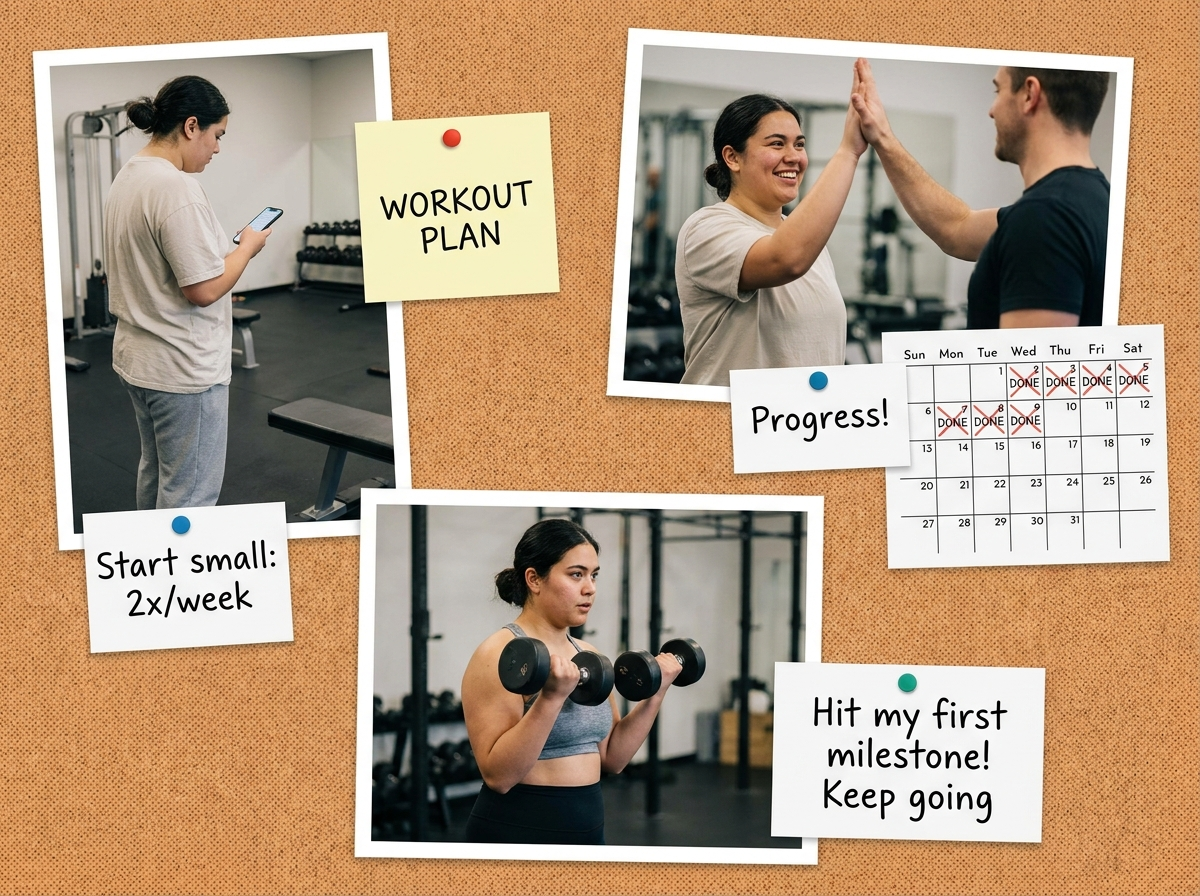
Going from zero to five sessions immediately. The classic mistake new gym starters make is going from zero to training five, six, or seven days a week — this just sets them up for failure because it is not realistic. Two to three well-structured sessions per week is a far stronger starting point. You can progress the frequency once the habit is cemented.
Ignoring the behavior-change dimension. Showing up to the gym is not automatic, and willpower alone depletes. Goal setting is considered a key part of health-related behavior-change programs and is included in most published health-coaching studies. Treat your gym attendance the same way you'd treat any new behavioral habit: schedule it, protect it, and track it with the same rigor you'd track a work deadline.
Setting goals that depend entirely on external variables. "Win the office fitness challenge" or "keep up with the advanced class" puts your success in other people's hands. Build goals around your own performance data, your own history, and your own schedule.
Skipping progress measurement entirely. Research has found that fitness tracking can increase individuals' self-awareness of task progress and activity level, which in turn positively affects task motivation. If you are not recording your sessions, you are navigating without a map.
Summary and Next Steps for Realistic Gym Goal Setting
Knowing how to set realistic gym goals for beginners comes down to three things: pair an outcome goal with a deadline, build weekly process goals you fully control, and track both consistently. Motivation is temporary; a well-structured goal system is not.
Keep going
Related tools on Sculpt
About this article

Written by
Dylan MartinezContent & Community at Sculpt
Dylan leads content and community at Sculpt, including editorial direction for the Sculpt research library.