What to Eat After the Gym to Recover Faster and Build Muscle
What you eat after the gym determines how fast you recover and grow. Here's the science-backed guide to post workout recovery nutrition for beginners.
Why What You Eat After Working Out to Build Muscle Actually Matters
You push hard in the gym. You follow a solid program. But if you walk out the door and skip your post workout recovery nutrition, you're leaving serious gains on the table. Knowing what to eat after working out to build muscle is the single most actionable nutrition decision you make on any training day. This guide covers the physiology behind recovery eating, the practical targets you need to hit, and the mistakes that most beginners make before they ever learn better.
Two things happen the moment you finish a training session. Your muscles are broken down at the microscopic level, and your stored energy in the form of glycogen is depleted. Every decision you make over the next two hours either accelerates repair or slows it down. Get the basics right, and your body builds back bigger and stronger. Get it wrong consistently, and you'll keep wondering why your progress stalls despite putting in the work.
The Science Behind Post Workout Recovery Nutrition
The mechanism at the heart of every post-workout meal is muscle protein synthesis, or MPS — the biological process your body uses to build new muscle tissue. Protein ingestion and resistance exercise both stimulate MPS and are synergistic when protein consumption follows exercise. In plain terms, eating protein after training amplifies the signal your workout already sent to your muscles. Skip the meal, and you cancel part of that signal.
Net muscle protein balance remains negative until food is ingested. Nutrition is required to allow proper muscle reconditioning and is a prerequisite for muscle hypertrophy to occur. This is the clearest argument for not skipping your post-workout meal, regardless of how much you ate earlier in the day.
The second piece of the puzzle is glycogen replenishment. During resistance and cardio training, your muscles burn through their stored carbohydrate. Carbohydrate intake during recovery is the most important consideration to replenish glycogen stores from an exhaustive exercise bout. Without adequate carbohydrates post-exercise, your muscles stay energy-depleted, recovery slows, and your next session suffers.
How Much Does Timing Actually Matter?
The concept of a rigid "anabolic window" — the idea that you must eat within 30 minutes or miss out entirely — has been heavily overstated. Any effect of protein timing on muscle hypertrophy, if in fact there is one, is relatively small. Total daily protein intake is by far the most important factor in promoting exercise-induced muscle development.
That said, timing is not meaningless. The effects of resistance exercise alone are potent and long-lasting, with basal fasted-state MPS being elevated for at least 48 hours. Your muscles are primed and receptive to nutrients for a significant window after training, not just for 30 minutes. A practical rule: aim to eat within two hours. Sooner is better, but later is still far better than skipping it altogether.
Your Practical Post Workout Meal for Beginners: What to Put on the Plate
Protein: The Non-Negotiable
This is where post workout recovery nutrition starts.
For building muscle mass and maintaining muscle mass through a positive muscle protein balance, an overall daily protein intake in the range of 1.4–2.0 g protein per kilogram of body weight per day is sufficient for most exercising individuals.
For your post-workout meal specifically,
consuming protein at a target intake of 0.4 g/kg per meal across a minimum of four meals reaches the minimum of 1.6 g/kg/day needed to build muscle.
For most beginners weighing between 60–90 kg, this translates to roughly 24–36 g of protein per post-workout meal. Practical sources include:
- Chicken breast or lean ground turkey
- Greek yogurt (plain, full-fat or low-fat)
- Cottage cheese
- Eggs and egg whites
- Whey protein shake (convenient if appetite is low after training)
- Tinned tuna or salmon
Understanding why protein is the most important nutrient for gym beginners will help you build this habit from day one.
Carbohydrates: Refuel the Engine
To maximally stimulate glycogen synthesis, sport nutrition recommendations are to consume 1.2 g of carbohydrate per kilogram of body mass per hour for 4–6 hours post-exercise.
For a typical beginner doing a 60-minute strength session, a more modest target, around 30–60 g of carbohydrates in your post-workout meal, covers recovery adequately without overcomplicating things.
Good choices include white or brown rice, potatoes, oats, fruit, and wholegrain bread. Ingesting carbohydrate and protein together produces improved overall muscle recovery, covering glycogen synthesis, repair, remodelling, and protein accretion from exercise, compared with carbohydrate alone. This is the core argument for pairing your protein source with a carb source rather than eating them separately.
Fats: Useful, but Not Urgent
Fat slows gastric emptying, which means large amounts of fat in your immediate post-workout meal can delay how quickly protein reaches your muscles. A small amount is fine — an avocado half or a drizzle of olive oil — but this is not the meal to prioritise very high fat foods.
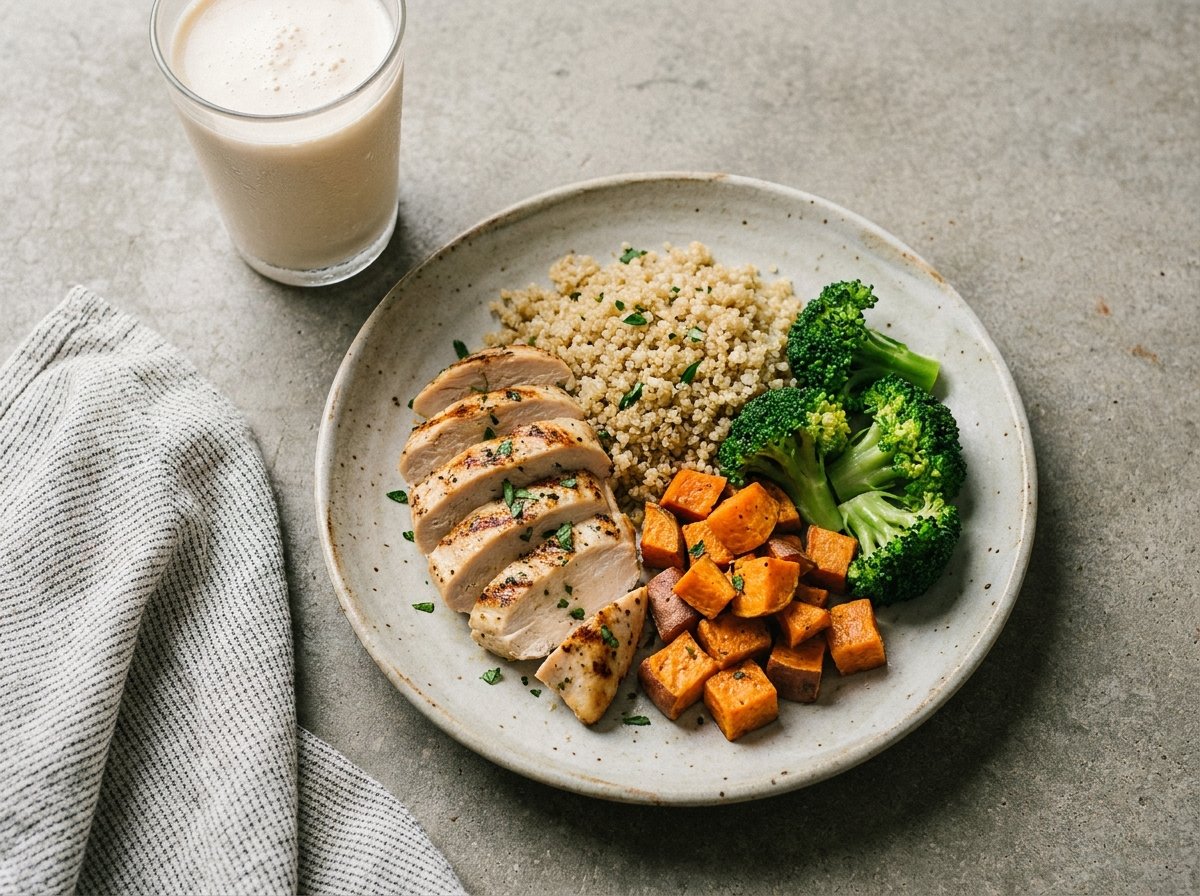
A simple post-workout plate: 150 g chicken breast, 200 g cooked rice, and a portion of steamed vegetables. Fast, balanced, and covers all the bases. For smarter meal timing throughout the rest of your day, the same principles of protein and carbohydrate pairing apply.
Common Post Workout Nutrition Mistakes to Avoid
Relying only on protein shakes. Supplements have a place, particularly when appetite is suppressed straight after training. Ingestion of protein-rich whole foods is capable of supporting post-exercise muscle protein remodelling by stimulating muscle protein synthesis rates. A shake works, but whole food meals provide additional micronutrients and fibre that supplements simply do not replicate.
Eating too little overall. The biggest mistake beginners make is nailing the post-workout meal but chronically under-eating for the rest of the day.
Research indicates that consumption of 1.6 to 2.2 g/kg per day of protein is needed to optimise muscle-building results.
Your post-workout meal is one piece of a full day of eating — not a substitute for it.
Skipping carbohydrates out of fear of weight gain. Carbs after training go to muscle glycogen, not body fat. If you're training hard and consistently skipping post-workout carbohydrates, your recovery will suffer. How carbohydrates affect your energy levels as a gym beginner is worth reading if you're still on the fence about including them.
Leaving it too long. If you trained in a fasted state — early morning with no pre-workout meal — post-exercise nutrition matters more urgently. The only time that post-workout nutrition is keenly important is when training is performed in the fasted state. In that scenario, eating within 30–60 minutes is worth prioritising.
Build the Habit, Track the Outcome
Post workout recovery nutrition comes down to three consistent actions: eat enough protein to drive muscle protein synthesis, pair it with carbohydrates to handle glycogen replenishment, and eat within a practical window after training. These are not complicated rules — they're repeatable habits.
The challenge for most beginners is not knowing what to eat, but tracking whether they're actually hitting their targets day after day. That's exactly where Sculpt AI earns its place. Log your post-workout meal by simply telling the AI what you ate — no tapping through menus — and instantly see your protein, carbs, and calories stacked against your daily targets. The app calculates your actual TDEE based on your stats and training frequency, so your nutrition targets reflect the real demands of your gym days, not a generic estimate. Build your go-to post-workout meals once and add them in a single tap every session after that. Recovery starts with what you eat — Sculpt makes sure you eat the right things consistently.
Sources
- Atherton, P.J. & Smith, K. (2012). Muscle protein synthesis in response to nutrition and exercise. PMC / Journal of Physiology
- Van Vliet, S., Shy, E.L., & Burd, N.A. (2018). Achieving optimal post-exercise muscle protein remodeling in physically active adults through whole food consumption. PMC / Nutrients
- Gatorade Sports Science Institute. (n.d.). Protein consumption and resistance exercise: maximising anabolic potential. GSSI
- Loon, L.J.C. van et al. (2008). Is there a need for protein ingestion during exercise? GSSI
- Schoenfeld, B.J. & Aragon, A.A. (2018). Is there a postworkout anabolic window of opportunity for nutrient consumption? JOSPT
- Thomas, D.T. et al. (2016). International Society of Sports Nutrition position stand: protein and exercise. PMC / JISSN
- Thomas, A.J. et al. (2021). Coingestion of carbohydrate and protein on muscle glycogen synthesis after exercise: a meta-analysis. PMC / Frontiers in Nutrition
- Schoenfeld, B.J. & Aragon, A.A. (2018). How much protein can the body use in a single meal for muscle-building? PMC / JISSN
- GSU Lewis College (2021). Fact or fiction: the anabolic window. Georgia State University
Keep going
Related tools on Sculpt
About this article

Written by
Dylan MartinezContent & Community at Sculpt
Dylan leads content and community at Sculpt, including editorial direction for the Sculpt research library.